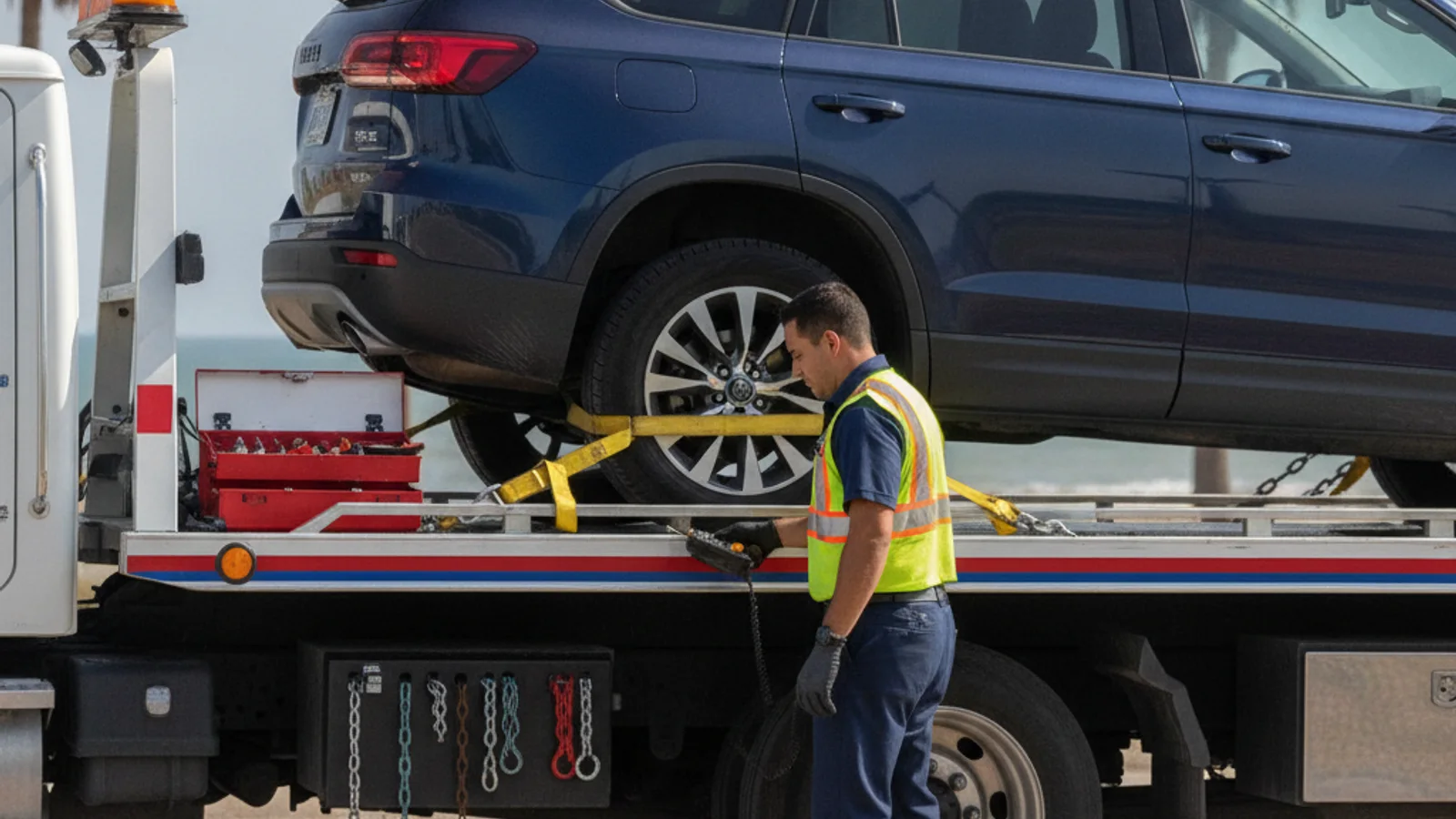
Check the owner’s manual before you accept a towing method. An all-wheel drive car is often discussed as a flatbed job, with all four wheels off the ground, because some other methods leave driveline parts turning while the engine is off. That is not a universal rule for every model. Call (361) 967-8088, say the car is all-wheel drive or that you are not sure, and ask the operator what equipment they plan.
If you take one thing from this page: say the words “all-wheel drive” when you call, or say you are not sure. Dispatchers route the request from what you tell them.
How do you tow an all-wheel drive vehicle?
Many manufacturers discuss a flatbed for AWD transport. The bed tilts down, the car is winched up, and all four wheels sit on the deck. Ask whether that is the method for your year, make, and model.
That covers a lot of crossovers and modern SUVs, but not by slogan. Flatbed towing is a common request for AWD cars. It is still the operator’s and the manual’s decision.
The two methods people ask about instead are a wheel-lift and a tow dolly. Both can leave one axle on the road. On some two-wheel-drive cars that can be acceptable. On many AWD cars there is no undriven axle. Ask rather than assuming.
What actually breaks when you tow AWD wrong?
The transfer case, or the centre differential and its coupling, depending on how the car is built. The owner’s manual and a qualified shop are the sources for that model.
In normal driving, the engine turns those parts and oil circulates. Some towing methods can reverse that: the road turns the driveline while the engine sits off. Heat and lubrication are the reason shops warn against it. Ask your shop what that job runs on your specific car before you accept a method the manual does not allow. This site publishes light-duty hookup from $125 for both flatbed and wheel-lift starting points. That is advertising, not a reason to skip the manual.
Can you tow an AWD car with a dolly?
Usually not, unless the owner’s manual allows that exact method. A dolly lifts two wheels and leaves the other two rolling, which is the condition many AWD drivetrains cannot tolerate.
People get this idea from RV flat-towing, where certain vehicles genuinely can be towed on all four wheels behind a motorhome. That works only on specific models with a transfer case the manufacturer allows to be shifted to a true neutral, and only when the owner’s manual spells out the procedure. It is a manufacturer-approved exception, not a general rule, and it is not what a roadside tow is doing.
Check the owner’s manual before you accept any method other than a flatbed. The towing section states what your specific car allows. If the manual is not in the glovebox, most manufacturers publish it free online. If nobody can find the answer at the roadside, the flatbed is the decision that cannot be wrong.
What about 4WD, and is it the same thing?
Close enough at the roadside, with one difference. A part-time four-wheel drive truck often has a transfer case with a real neutral position, which sometimes allows other methods. A full-time AWD crossover usually does not.
If the car has a badge saying AWD, 4WD, 4x4, quattro, xDrive, 4MATIC, SH-AWD or similar, tell the operator and ask them to confirm the method. The same caution applies to many electric vehicles: rolling wheels can turn motors. Follow the manufacturer procedure rather than a generic EV rule.
Does this come up much around Corpus Christi?
More than you would think, and for two local reasons.
The first is the beach. Padre Island and the down-island access roads pull in exactly the vehicles that are all-wheel drive, and soft sand is where they stop. A vehicle bogged in sand needs a winch-out first, and once it is back on solid ground it either drives away or it goes on a flatbed. It does not get dragged out on two wheels. Down-island calls run out past the county park line on Padre Island, so give the operator your last landmark while you still have signal.
The second is water. Corpus Christi floods fast in a heavy rain and the low spots on SPID, the Crosstown and the older Westside streets fill quickly. A car that has been through standing water should never be started, and if it is AWD it also should not be wheel-lifted. Our guide to a flooded car in Corpus Christi covers why starting it is the expensive mistake.
There is also a practical one: a lot of the crossovers on the road here are AWD without their owners really registering it, because it came standard on the trim. If you are not certain what you are driving, say so on the call. Nobody minds the question.
What do you tell the dispatcher?
Five things. The call does not have a fixed length.
- That the vehicle is all-wheel drive, or that you are not sure. Either answer is useful.
- Year, make and model.
- Whether all four wheels turn freely, and whether any are flat or locked up.
- Exactly where it is, including whether it is in sand, mud, water or a tight garage.
- Where it is going.
Then ask what truck is coming. If the answer is not what the manual supports, ask why before you agree.
Frequently asked questions
How do you tow an AWD vehicle?
Often on a flatbed, with all four wheels off the ground, when the manufacturer supports that method. Tell the dispatcher the car is all-wheel drive and ask what equipment they plan, whether it is a breakdown or emergency towing after a wreck.
Can you tow an all-wheel drive car with a wheel lift?
Not without checking the manual. A wheel-lift can leave one axle turning on the road. Ask the operator and a shop before you accept that method.
How much does it cost to flatbed an AWD car in Corpus Christi?
Our published rate starts at the same $125 local hookup as any light-duty tow, then roughly $3 to $5 a mile past the first five. There is no published AWD surcharge. Calls between 10 p.m. and 6 a.m. add $25 to $50, and the operator matched to your call confirms the total before starting.
Is a flatbed really necessary, or is that an upsell?
The manual decides. This site publishes flatbed and wheel-lift from the same $125 hookup, so the published starting figure is not a reason to skip the right method.
Do electric cars need a flatbed too?
Often, but follow the manufacturer. The motors can be geared to the wheels. An EV out of range is not a fuel-drop job. Ask for the transport method that model allows.
What if my manual says the car can be flat-towed?
Then it can, under the exact conditions the manual gives. Follow that procedure, or take the method the operator can actually perform at the roadside.
My car is stuck in sand on Padre Island and it is AWD. Now what?
It may need a winch-out onto solid ground first. If it drives normally after that, there may be no tow. If it does not, ask about a flatbed. Do not assume it will be dragged out with two wheels down.
Driving something all-wheel drive and need it moved? Call (361) 967-8088, say those three words, and ask which truck the operator is sending.