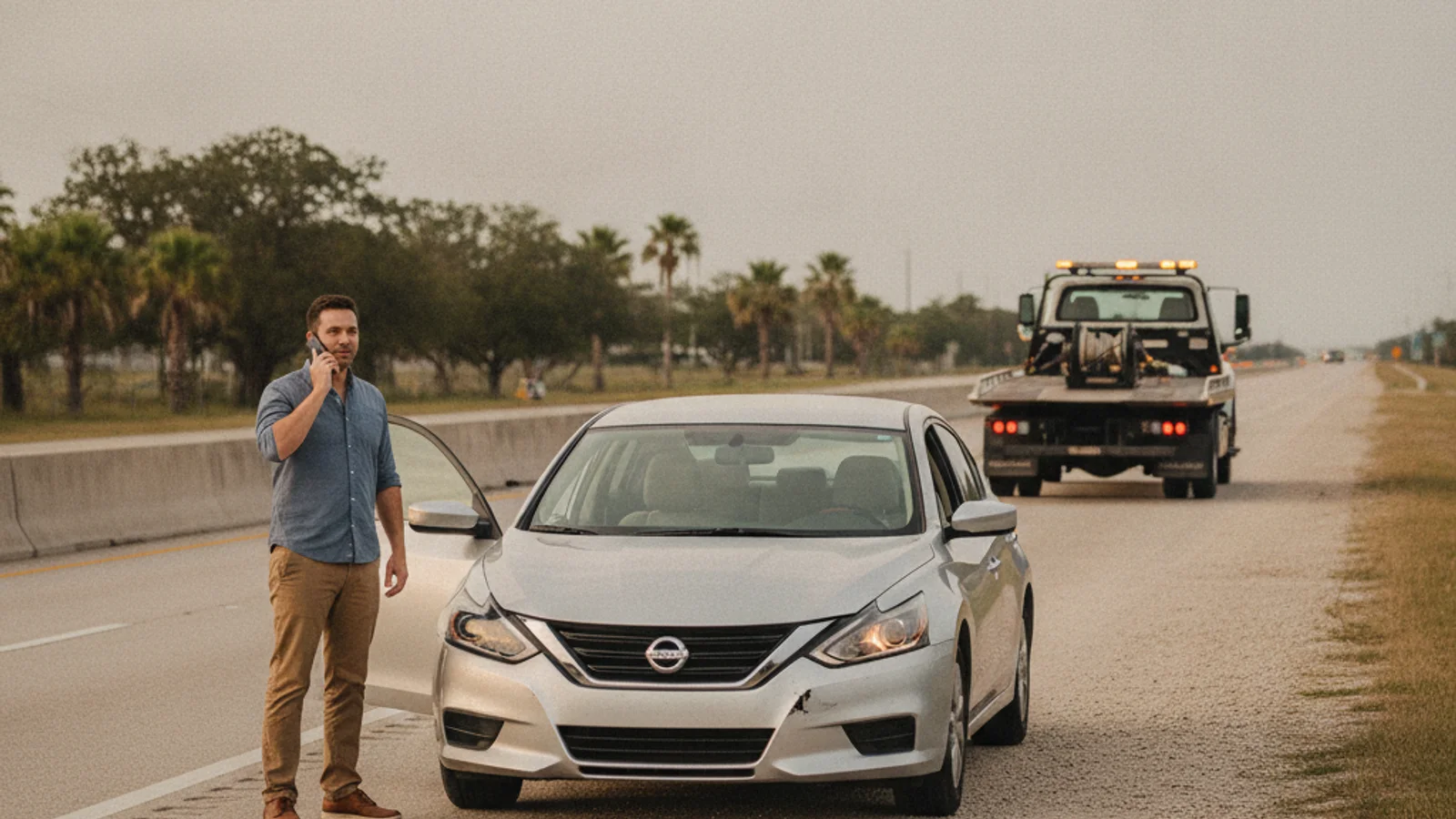
If you’re reading this from the side of the road, here’s the short version. Move your car out of the travel lane if it still drives and nobody’s hurt, check everyone for injuries, and call 911 if anyone needs help or the wreck is blocking traffic. Exchange information with the other driver, take photos before anything moves, and figure out whether you need a police report. Once the scene is handled, you still need to get the car somewhere it can be looked at. Call Quick Tow Corpus Christi at (361) 967-8088. The referral line connects you with an independent operator while you work through the rest of this list.
Move to safety first, if it’s safe to move
Texas law actually asks you to do this. Under Transportation Code Section 550.022, if a crash happens on a freeway main lane, ramp, shoulder, or median in a metro area and each vehicle involved can still be driven normally and safely, the drivers are supposed to move to the nearest safe spot, a frontage road, the closest cross street, or another suitable location, to finish exchanging information without blocking traffic. On SPID, the Crosstown, or the approach to the Harbor Bridge, sitting in a live lane at highway speed is more dangerous than the crash itself. Getting to the shoulder matters more than preserving the exact spot where the cars stopped.
That rule only applies if the car actually drives. If it won’t start, has a flat, or leaked fluid across the lane, don’t force it. Turn on your hazards, set out flares or triangles behind the vehicle if you have them, and treat it as a wait-for-help situation instead of a move-it-yourself one.
Check for injuries and call 911 if anyone needs help
Before you think about paperwork, check yourself and every passenger for injuries, including the kind that don’t hurt yet. Adrenaline can hide pain. Check everyone again after a few minutes. Call 911 right away if anyone is hurt, if the vehicles are blocking a travel lane and can’t be moved, or if the crash involves a commercial truck, a hit-and-run driver, or someone who looks impaired. Texas law requires you to stay at the scene and provide reasonable assistance to anyone injured, which can mean calling for an ambulance even when the person who needs it isn’t you.
Document the scene before anyone leaves
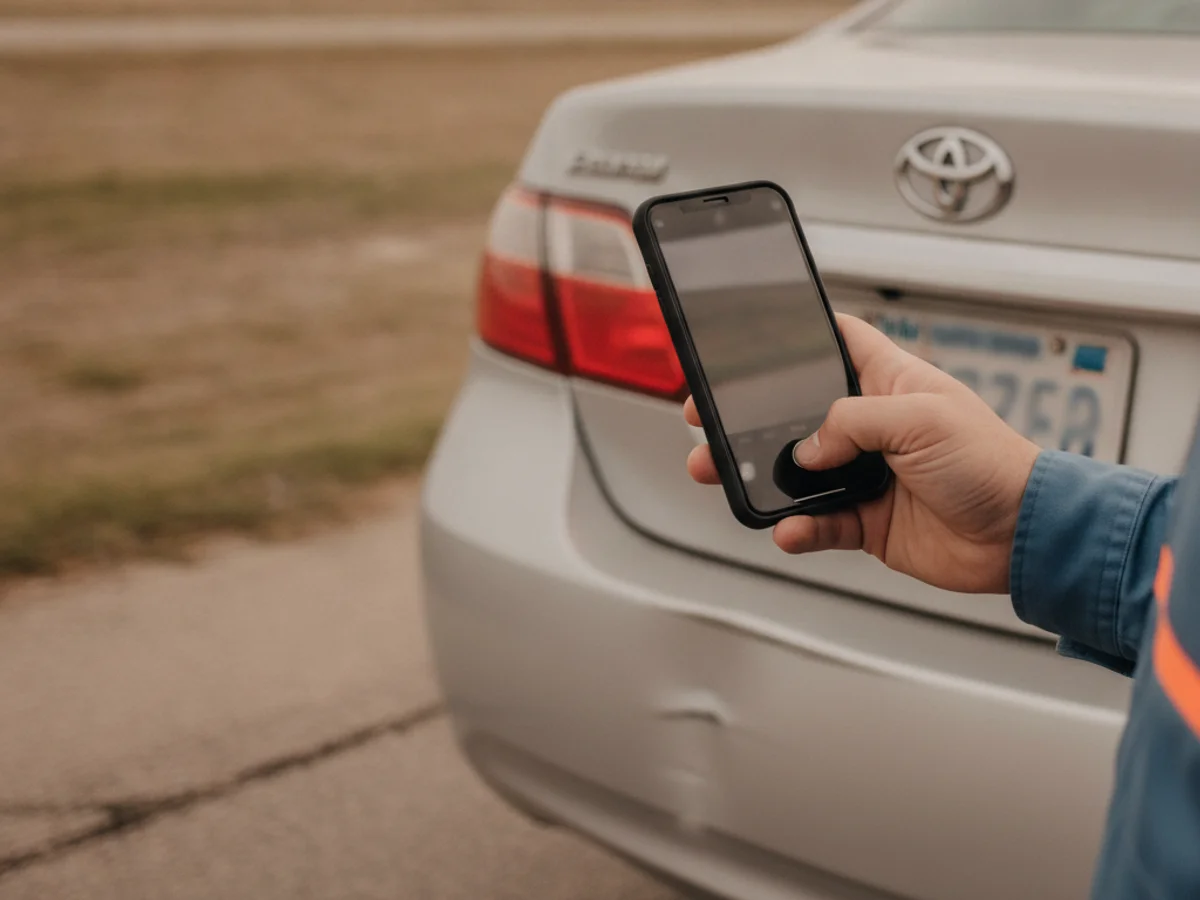
Once everyone’s safe, start documenting. Photograph both vehicles from a few angles, the damage close up, the license plates, and the wider scene, including skid marks, debris, and the exact intersection or landmark, SPID and Staples, the Harbor Bridge, the Crosstown interchange, wherever you actually are. Under Texas Transportation Code Section 550.023, you’re required to give the other driver your name, address, vehicle registration number, and the name of your liability insurer, and show your license if they ask for it. It’s smart to also swap phone numbers and policy numbers, since that’s not legally required but it speeds up the claims process considerably. If anyone stopped to watch, get their name and number too. Photos and names matter more than memory once the adrenaline wears off and the insurance calls start.
When you need a police report in Corpus Christi
Texas requires a crash report in situations set out in Transportation Code Chapter 550, including injury, death, or property damage at or above the current statutory threshold. Confirm the current threshold and whether an officer will respond. If the crash is blocking traffic, involves an injury, or looks like more than a minor fender-bender, call 911. For a minor, no-injury crash that’s already off the road and clear of traffic, call the Corpus Christi Police Department’s non-emergency line at (361) 886-2600 and ask whether an officer needs to come out. Keep any report number you are given. Your insurer may ask for it.
Who pays for the tow after a car accident
This is the question everyone actually wants answered, and it depends on your coverage. Ask the named insurer. If another driver caused the crash, their liability coverage may later reimburse reasonable towing as part of a property-damage claim, once fault is sorted out. If you carry collision, comprehensive, or a roadside add-on, your own insurer may have a faster path. Texas uses a modified comparative-negligence rule: ask a lawyer or the insurer how that applies to your share of fault. If you pay out of pocket, keep the itemized receipt. Either way, ask for a quoted total before the truck rolls.
Corpus Christi’s most dangerous stretches, and why it matters
Some roads here see more crashes than others. SPID (SH-358), especially around Staples Street, Airline, Kostoryz, and Everhart, is a frequent local reference in news and city discussion of rear-end crashes. Treat those names as location cues, not as a verified crash-count table.
The Harbor Bridge on US-181 is steep, high, and exposed to Gulf crosswinds. A vehicle that breaks down or gets hit up there may not be reachable until traffic is controlled. If you’re on that bridge and the car still drives, get across it before you pull over if you can do so safely. The Crosstown Expressway (SH-286) feeds both SPID and I-37. Wherever you’re stranded across Corpus Christi and the Coastal Bend, tell the referral line the nearest cross street or mile marker.
Getting your car towed after the wreck
What happens next depends on how the car is sitting and how bad the damage is. A car that’s still on all four wheels and rolls straight is often discussed as flatbed towing. A car that’s off the road entirely may need a winch-out (learn more) before it can be loaded. That’s accident recovery work. The operator on scene decides the method.
You choose the shop, not just the nearest lot. Ask whether the operator will speak with your insurer. They may, or they may not. If police order the vehicle towed because it’s blocking a lane and you weren’t there to choose, it may end up at the city impound instead. See how to get your car out of impound in Corpus Christi.
Call Quick Tow Corpus Christi at (361) 967-8088. The referral line takes calls day or night. Ask the operator taking the job for timing while you handle the rest of the list.
Frequently asked questions
What should I do first after a car accident in Corpus Christi?
Move your car out of the travel lane if it still drives and nobody’s hurt, then check everyone for injuries and call 911 if anyone needs help or the vehicles are blocking traffic. Once you’re safe, exchange information with the other driver and start taking photos before anything gets moved.
Do I have to call the police after every accident in Corpus Christi?
Texas requires a crash report when a crash causes injury or death, or property damage at or above the current statutory threshold. Confirm that threshold. For a minor crash that’s already off the road, call the CCPD non-emergency line at (361) 886-2600 and ask whether an officer needs to respond.
Who pays for the tow truck after an accident?
Ask the named insurer. If another driver is at fault, their liability coverage may later cover reasonable towing and storage. If you carry collision, comprehensive, or a roadside add-on, your own insurer may have a faster path. Texas comparative-negligence rules can reduce recovery based on your share of fault.
Can I move my car after an accident on SPID or the Harbor Bridge?
Yes, and Texas law actually asks you to, as long as the car can be driven normally and safely. Moving off the highway to the shoulder, a frontage road, or the nearest cross street gets you out of live traffic and clears the lane faster. Only leave the car in place if it won’t drive or someone needs medical attention before it’s safe to move.
What if my car isn’t safe to drive after the wreck?
Turn on your hazards, stay clear of traffic, and call for a tow. If the car is still on all four wheels, ask about a flatbed. If it’s off the road, in a ditch, or against a guardrail, it may need a winch-out first. Call (361) 967-8088 and ask the operator which method they plan before they leave.
How fast can Quick Tow Corpus Christi get to an accident scene?
The line takes calls 24/7 across Corpus Christi and the Coastal Bend. The job is referred based on where you are and what the vehicle needs. Call (361) 967-8088 and give the nearest cross street or mile marker. Ask the operator taking the job for their timing before you hang up.